Unusual military activity in Nigeria’s airspace has raised fresh questions about the scope of a growing security partnership between Abuja and Washington, following reports that a United States surveillance aircraft was sighted flying over Kwara and Ekiti States.
Thank you for reading this post, don't forget to subscribe!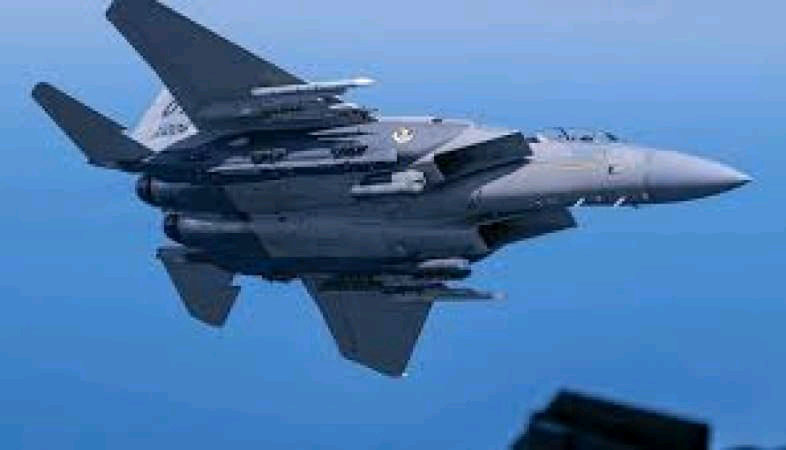
According to security analysts, the operation marks a significant shift in U.S. intelligence, surveillance and reconnaissance (ISR) activity in the region, with potential implications for Nigeria’s counterterrorism strategy.
The development comes as senior U.S. officials reportedly arrived in Abuja on Wednesday night, fuelling speculation about imminent announcements regarding bilateral security arrangements. While the Nigerian government has yet to issue an official statement, emerging information from defence experts suggests that Washington may be deepening its involvement in Nigeria’s fight against extremist groups.
Security expert and Sahel conflict reporter Brant Phillip earlier disclosed that U.S. reconnaissance flights were being conducted over parts of western Nigeria, reportedly originating from a U.S. military facility in Ghana. His initial report drew wide reactions after suggesting that the operations were underway without any publicly acknowledged authorization from the Nigerian government.
On Thursday, Phillip shared further updates indicating that the U.S. Air Force had extended its ISR operations into southwestern Nigeria, marking what he described as “the first time the U.S. is conducting ISR in southwest Nigeria.” According to him, the surveillance aircraft flew over Kwara and Ekiti States, spending extended periods gathering intelligence.
“For the first time, the U.S. is conducting ISR in southwest Nigeria, above Kwara and Ekiti States. This comes following the potential arrival of U.S. officials in Abuja last night,” he wrote.
ISR—intelligence, surveillance and reconnaissance—plays a critical role in modern counterterrorism operations, enabling militaries to detect threats, observe movement and track militant activities across vast areas.
Phillip further revealed that U.S. aircraft were also conducting surveillance in IS-Sahel-dominated regions of northern Nigeria, including Tangaza Local Government Area of Sokoto State—an area that has seen escalating militant activity linked to Islamic State affiliates.
He noted that U.S. aircraft spent more than an hour over Kainji in Niger State and an additional one and a half hours over Tangaza, with transponders intermittently switching on and off—a technique associated with covert intelligence-gathering missions.
According to Phillip, the Sokoto flights marked the second consecutive day of ISR activity and the sixth day of combined surveillance across two Islamic State–influenced regions in Nigeria.
One of the most significant claims in Phillip’s reporting comes from a private source he says is familiar with ongoing military discussions between Washington and Abuja. According to the source, the U.S. has been granted permission—under a yet-to-be-announced security agreement—to conduct unmanned aerial vehicle (UAV) airstrikes against terrorist targets inside Nigeria. The alleged arrangement reportedly authorizes only unmanned aircraft, excluding manned fighter jets or bombers from carrying out offensive operations.
This would mean any potential U.S. airstrike campaign in Nigeria would rely solely on armed drones.
“The U.S. will be allowed to conduct UAV airstrikes against terrorist targets inside Nigeria. The scope only includes unmanned aircraft, not fighter jets or bombers,” Phillip quoted his source as saying.
There are also indications that the U.S. may use Kainji Air Base in Niger State as its operational hub for ISR missions and possible UAV strikes. Kainji, one of Nigeria’s largest military air facilities, has a history of hosting foreign military collaborations, including previous partnerships with the United States. Phillip noted, however, that this detail remains “likely but unconfirmed,” as neither government has officially announced such an arrangement.
He added that the U.S. role in the partnership would likely center on filling intelligence gaps that the Nigerian Army and Air Force struggle to cover due to limited ISR capabilities, including both manned aircraft and UAVs.
These developments come after a period of diplomatic tension between Abuja and Washington. News Week Nigeria previously reported that U.S. President Donald Trump redesignated Nigeria as a “country of particular concern” over alleged killings of Christians—a move that increased scrutiny of Nigeria’s internal security efforts and human rights record.
Despite political disagreements, recent events suggest that the U.S. views Nigeria’s deteriorating security landscape—marked by Islamic State affiliates, Boko Haram and other armed groups—as necessitating renewed military engagement.
What This Means for Nigeria’s Security Landscape
If confirmed, the authorization of U.S. UAV airstrikes in Nigeria would represent one of the most significant foreign military collaborations since the Multinational Joint Task Force (MNJTF) operations around Lake Chad.
The expansion of U.S. ISR activity into the relatively stable southwest signals Washington’s concerns about evolving militant networks and possible expansion corridors.
For many Nigerians, the flights raise urgent questions:
Has a new defence agreement already been signed?
Why has there been no official communication from the federal government?
What are the implications for Nigeria’s sovereignty?
Analysts warn that while U.S. assistance may strengthen counterterrorism operations, transparency is essential to avoid public distrust and constitutional concerns regarding foreign military activity on Nigerian soil.
As of Friday morning, neither the Nigerian Ministry of Defence, the Nigerian Air Force nor the U.S. Embassy in Abuja had issued statements on the reported flights or the alleged agreement.
Until official confirmation emerges, the increased air activity—and the arrival of U.S. officials in Abuja—will continue to fuel speculation about the intent and scale of the evolving security partnership between the two nations.
Kindly share